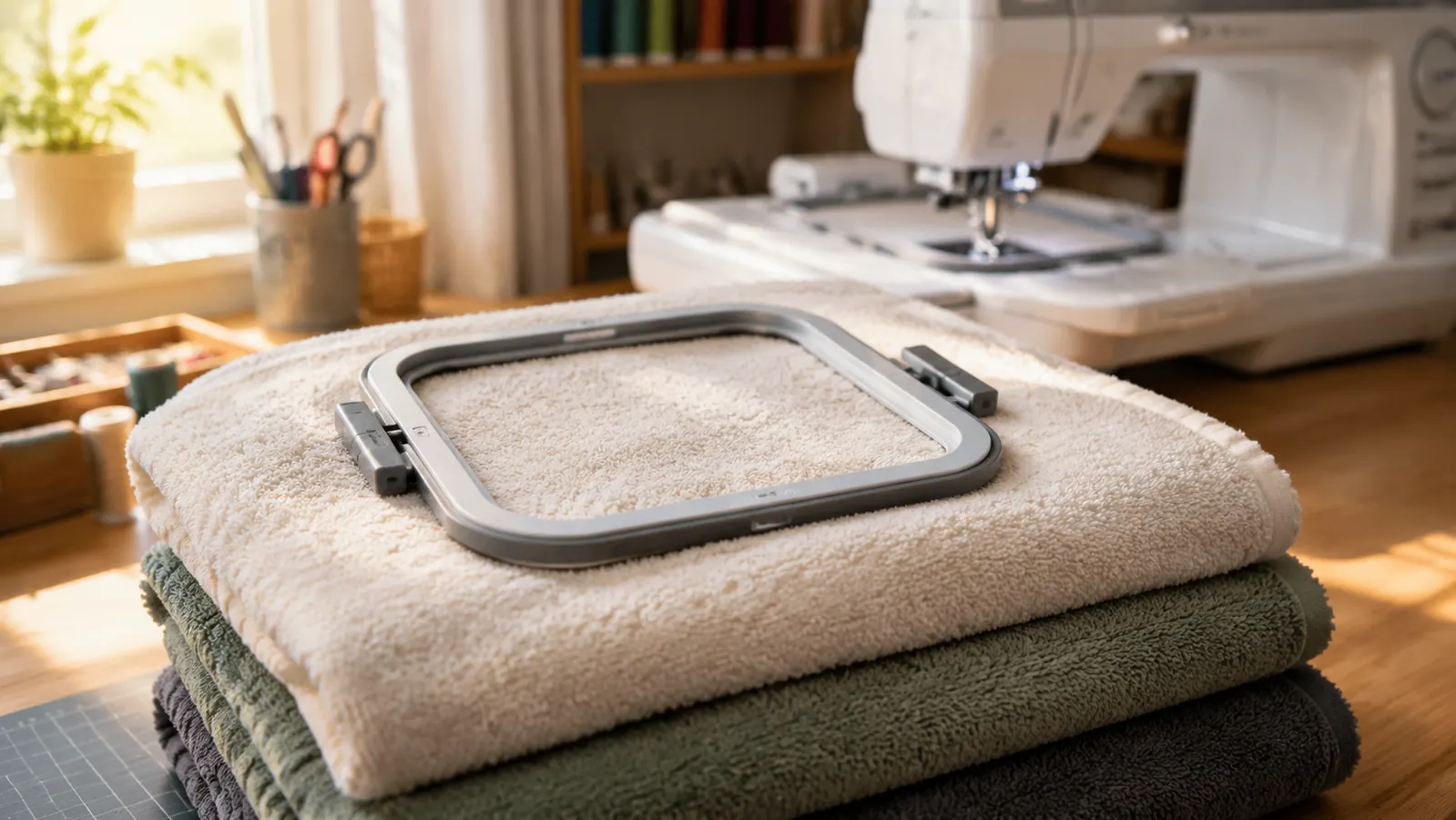
I keep a box of would-be samples in the closet, pieces where the final stitch wandered far enough that I couldn't in good conscience hand them over. My old screw hoop caused more do-overs than my machine ever did. When I finally ordered Sew Tech's 6 by 10 magnetic embroidery hoop for Brother, I let it sit on my workbench for two days while I finished a rush order on my six-needle. Then I took a deep breath, hooped a thick bath towel, and let the magnet do what the screw never did. I'm not saying it's perfect. After six months of paid work, I can tell you where it shines and which jobs I still keep a standard hoop for.
This review is my way of sharing that notebook. I run a one-woman embroidery shop from a spare room in Macon, Georgia. My machine is a six-needle that I bought used in 2019, and I mostly do the slow work that keeps a local shop busy, left chest polos, towels for little league sponsors, canvas tote bags for a barbecue place, and fleece throws for a church fundraiser. Every one of those materials reacts to hooping differently. A thick towel fights you. Slippery polyester will slide no matter how hard you clamp. A stiff canvas bag has seams that get in the way. When someone asks if a magnetic hoop is worth it, the real answer is: it depends on which fabric you mean. This review is about what happened when I used it across all of them for six months.
The Quick Verdict
Holds thick towels and fleece flat with no hoop burn and no re-hooping, but it will not tame slippery athletic fabric and it needs a flat, seam-free work area.
Amazon Check Today's Price →Give the screw hoop the day off.
If you run towels, fleece, or canvas through a machine that accepts a 6 by 10 Brother-style hoop, this is the first thing I would add next to the bobbin case. Check today's price on Amazon and read the compatibility list before you order.
Amazon Check Today's Price on Amazon →How I've Used It
From the end of November through May, I used this hoop on over four hundred customer pieces. I did not treat it like a lab sample. I kept a spiral notebook on the thread stand and wrote down every slip, every tear-out, and every time the registration stayed better than I expected. The largest single order was 57 burgundy shop towels with a 4 inch logo for a local HVAC company. Burgundy is a merciless test fabric because the white underlay shows any registration drift as a pale halo. If a hoop is going to shift, burgundy towels will catch it before you finish the first row of stitches. I also ran 120 white bath towels, forty 12 ounce fleece blankets, and thirty five canvas tote bags. That is a broad enough sample to make the complaints mean something.
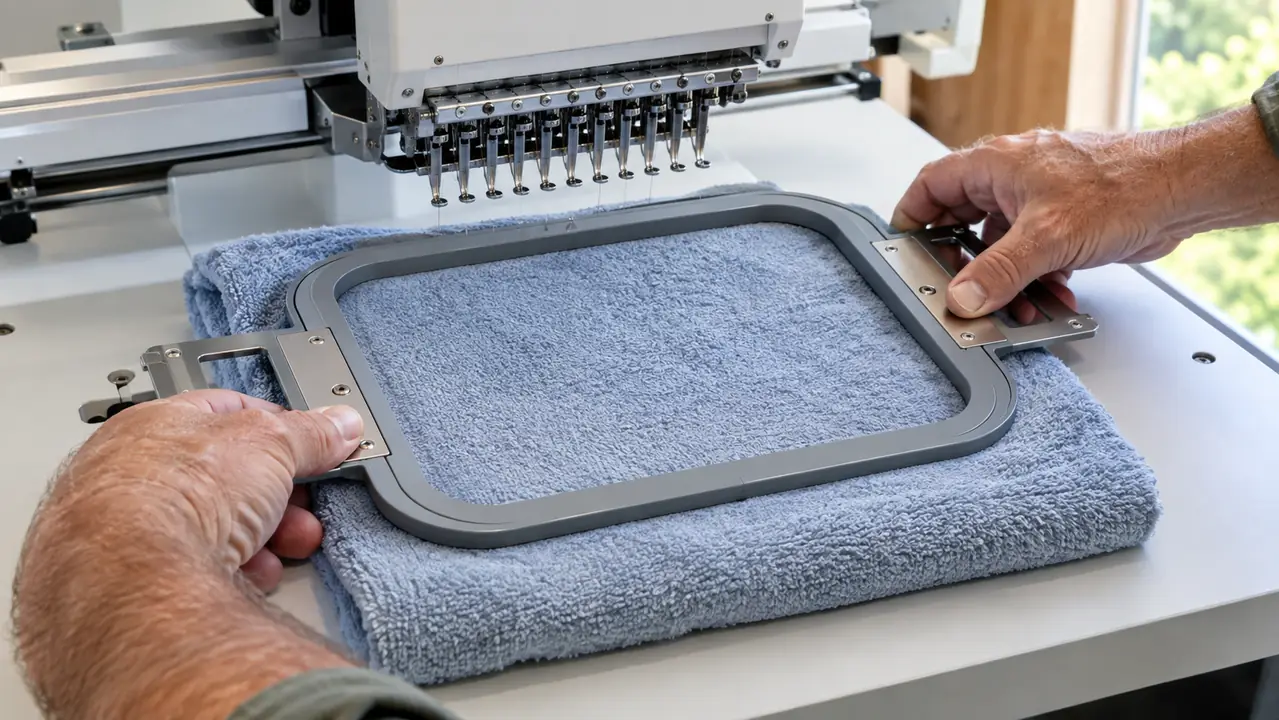
The first thing to understand is that the magnetic hoop is not a ring that clamps down on the outer edge. It is a flat base plate and a separate top plate with magnets built into it. You lay the fabric over the base, smooth it from the center with the heel of your hand, and then drop the top plate onto it. The magnet pulls the two plates together across the full 160 by 260 millimeter field. There is no screw to tighten and no grid to align because the fabric is held in place by even pressure rather than by tension at the outer rim. That sounds like a small mechanical difference, but it changes how thick fabric behaves under the needle.
I will give you one number from my notes. On the burgundy shop towel run, I made a small alignment tick on the seam allowance of each towel and measured the distance from the edge of the logo to that tick after every tenth piece. The logo stayed within one sixteenth of an inch across six measurements. By the end of the same order, my old screw hoop would have drifted an eighth of an inch and I would have pulled two or three towels to rehoop them. I have never had a screw hoop hold a stack of heavy towels that flat for that many pieces in a row. That is the kind of proof that tells you the design is doing something different.
Why the Magnetic Hoop Wins on Towels and Fleece
The easiest problem to see is the thing embroiderers call hoop burn. A screw hoop has to squeeze the fabric hard enough that it cannot move between the two plastic rings. On a bath towel, that pressure crushes the terry pile around the outer edge and leaves a permanent crease line that does not wash out. With the magnetic hoop, pressure is spread across the whole flat area where the two plates meet, so there is no single ridge digging into the fibers. At the end of the 57 towel run, I checked the backs of all 57 pieces. Not one had a hoop mark that would bother a customer. That alone made the tool worth my attention.
The second reason is stability in the center of the hoop. A standard frame holds fabric at the edges, so the middle of a big design can act like a drum head. When a needle punches into the terry at high speed, the material can push sideways under the stabilizer. The magnetic plate presses directly on the working area, so the towel cannot slide in the middle when the needle bounces. That is why the magnet is not just about easy loading. It is the part that keeps a 4 inch logo square on a thick shop towel.
Fleece behaved differently from terry, but it was actually the better result. Knit fleece will stretch if you pull it too tight when hooping, and the stretch does not show until the piece is washed and the border comes out wavy. With the magnetic hoop, you do not pull the fleece at all. You smooth it across the base plate and let the top plate settle on its own. The forty church blankets came off the machine square and flat. I have sewn the same design on the same fleece with my old hoop, and I generally rehooped two or three pieces because the knit had stretched out of shape. No stretching means no wavy edges.
The third advantage appears between pieces. I clocked myself with a stopwatch on two different mornings. With the screw hoop, loading and centering a bath towel took thirty to forty seconds. With the magnetic hoop, my average over ten towels was seventeen seconds. For a batch of thirty five totes or twenty towels, that saves five to nine minutes. That does not sound enormous, but when you work alone and run a six needle from a spare room, enough five minute pockets disappear to change how many jobs you can finish in a day. It is the quietest way this hoop makes money for a small shop.
Where It Fell Down for Me
Now the part I would have wanted to read before I bought it. The first failure came on twenty thin performance polo shirts for a local soccer team. The fabric was smooth, slightly stretchy, and coated with a wicking finish that is hard to grip. On the third shirt, the logo had walked about an eighth of an inch toward the placket. By the fourth, it was close to a quarter of an inch off. I switched to my old plastic hoop, which has a rubber gripper along the inside channel, and the remaining shirts sewed clean. The magnetic surface is simply too smooth to keep that kind of wicking polyester from sneaking sideways at speed.
The second issue is bulk and seams. A magnetic hoop works only if both plates sit flush against each other over the entire working area. If a hem or a seam is trapped inside the field, it will raise the top plate on one side and leave a tent across the middle. I found this on my first canvas tote bag order. I did not think about the heavy bottom seam before I put the hoop down, and every needle pass over that raised section skipped or elongated the stitch. I stopped the run, moved the tote up two inches so the seam sat outside the plate, and the next three pieces sewed perfectly. You simply have to treat the area inside the hoop like a flat table, because that is exactly what it is.
The third limit is pile. A long fluffy fleece or a high-pile towel still needs a water-soluble topping sheet. The magnet will keep the ground fabric still, but it cannot stop the nap on top from working up through the embroidery and leaving lint caught in the stitches. I sewed eight test letters on napped toweling without topping just to see if the magnet would do the job alone. Two of the eight came out with fuzz trapped around the edges, and I stopped the test. Anyone who says a magnetic hoop replaces topper has not run a towel order with a deadline.
What I Changed in My Setup
Once I accepted that this hoop was going to stay on my table, I made three changes to the rest of my setup. First, I stopped hooping a separate piece of cut-away backing underneath the fabric with a second frame. The extra rim made the whole stack too thick for the magnetic plates to sit level. Instead, I float a 2.5 ounce cut-away sheet on the base plate and set the towel on top of it before the magnetic plate goes on. The backing stays in place because it is trapped by the same magnet that holds the towel. That gives the needle a solid foundation and keeps the registration true on the densest fills.
Second, I added about eight percent to my fill density on fleece and towels. The magnetic plate presses the fibers flatter than a screw hoop, and flatter fabric means a fill stitch may look thinner than it did before. The first fleece blanket I ran with a dark navy monogram came out grainy because the threads sank into the compressed pile. I increased the density from 0.45 millimeters to 0.42 millimeters and the next one looked solid. That change took me one failed sample to make. If you are moving from a screw hoop to a magnetic hoop, run a test stitch before you commit an entire order.
Third, I switched to a 90/14 ball point needle for terry and fleece. I had a week of skip stitches that made me question the hoop, and the cause was a dull 75/11 sharp needle from a previous hat job. A ball point tip parts the thick fibers instead of cutting them, and the larger eye lets the thread run through without shredding at high speed. After I changed the needle, my thread breaks dropped from about one every four towels to one in an entire wash day. The lesson is that a magnetic hoop will not save you from a tired needle. Keep a fresh one and you will stop blaming the frame for what is really a needle problem.
By the time I packed away the winter season, my notebook listed four tear-outs across the four hundred pieces. Three of those were my own setup errors: two seam placement mistakes and one time I reached for tear-away on a towel that needed cut-away. The fourth was a bobbin case that needed a cleaning, which had nothing to do with hooping. I have ruined more pieces than that in one afternoon with my old screw hoop. That is the real conclusion after six months, if I had to put it in a single sentence.
What I Liked
- Even magnetic pressure across the 160 by 260 millimeter field keeps towels and fleece from shifting mid-design
- No hoop burn or crushed pile on thick fabric
- Fast 17 to 20 second loading per piece
- Registration held within one sixteenth of an inch on a 57 piece towel run
Where It Falls Short
- Smooth performance polyester can still slide under the magnetic plate
- Seams and hems inside the design area cause the plates to sit uneven
- Still requires a water-soluble topping for high pile fabrics
- Only fits machines that accept a Brother style 6 by 10 hoop
Fifty seven burgundy shop towels came off my machine without a single re-hoop. That has never happened with a screw hoop.
Who This Is For
Buy the Sew Tech hoop if you do what I do: bath towels, kitchen towels, fleece throws, canvas tote bags, and any other medium or heavy material that needs to sit flat in the hoop. It is especially helpful when you are the only person doing the hooping and the order is 40 or 50 pieces. The even magnetic pressure takes the guesswork out of tightening and the time off the setup. If you are a home embroiderer with one six needle and you have been living with hoop marks on towels, this is the tool I would try first. It held up through a full winter of school, church, and team orders with no complaints.
Who Should Skip It
Skip this hoop if your business is mostly caps, because a cap needs a curved frame, not a flat plate. It is also a bad fit for smooth wicking jerseys, very lightweight shirts, and anything made of slippery athletic polyester. And before you buy any magnetic hoop, determine whether your machine accepts the Brother style 6 by 10 format. The 160 by 260 millimeter field is not a universal size. There is no way to adjust it to a different hoop mount. Read the compatibility list that comes with the Sew Tech listing, compare it to the frame system on your own machine, and do not assume it will snap in just because the title says Brother.
Give your towels a flat hooping experience.
Sew Tech's 6 by 10 magnetic hoop is the one I reach for first after six months of real order work. If your machine takes a Brother style 160 by 260 millimeter hoop, check today's price on Amazon. If it does not, keep scrolling and save yourself the frustration.
Amazon Check Today's Price on Amazon →