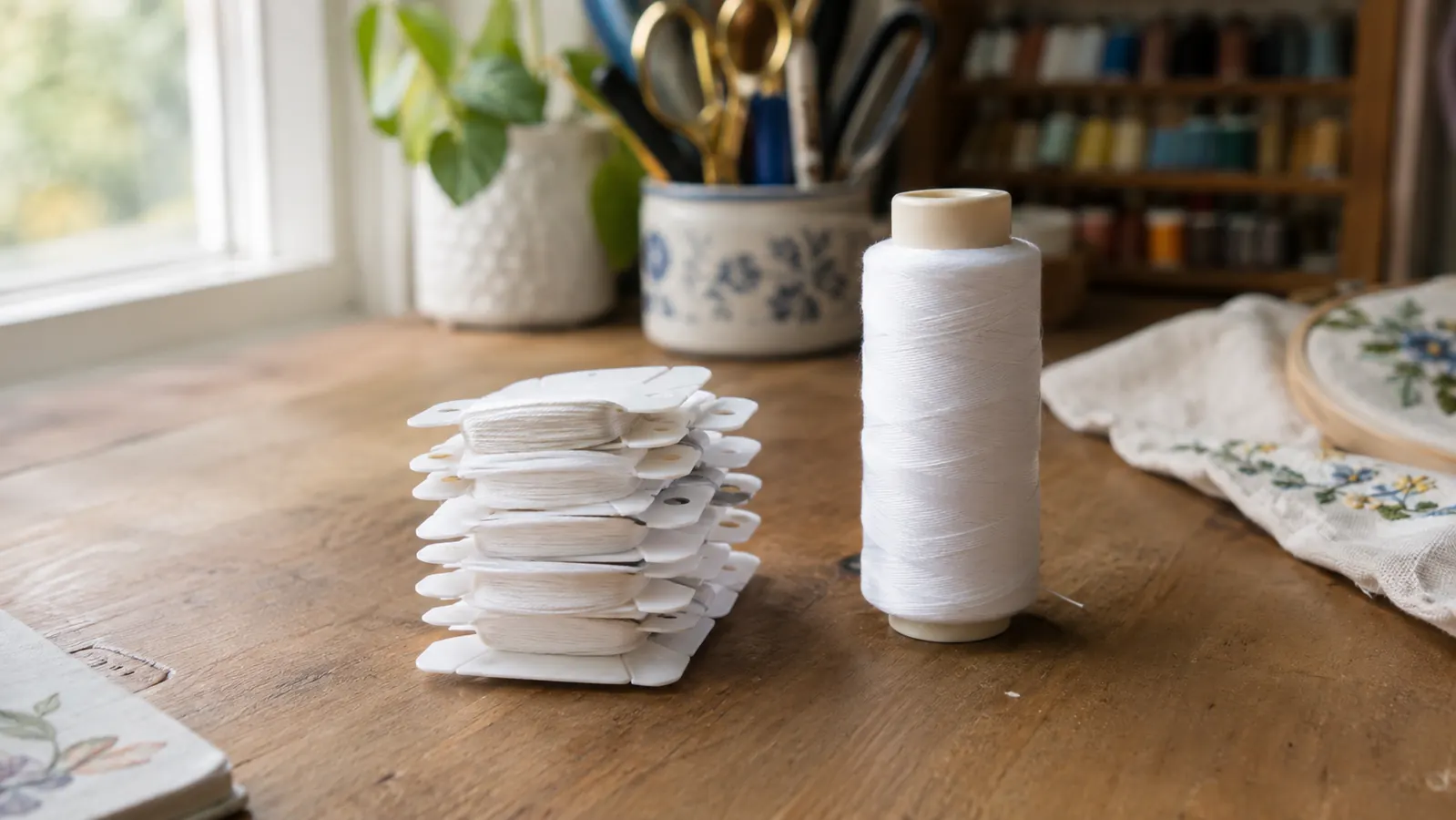
I will tell you straight: I bought my first box of DOUBLELIN prewound bobbins because I was tired. Tired of winding bobbins at 10:30 at night before a 7:00 AM rush order for a church bazaar. Tired of the little plastic winder on my six-needle clicking like it was about to give up. Tired of guessing whether I had enough bobbin thread for a 10,000-stitch design and losing that bet at stitch 9,200. So I ordered the 144-count box of DOUBLELIN size A bobbins, white, and I have now run them through more than 40 orders, somewhere north of 300,000 stitches by my rough count. This is the honest review I wanted to read before I switched, including the parts that would have stopped me from buying them if I had known earlier.
If you run a single-needle machine for the occasional monogram, prewound bobbins are a nice convenience. If you run a multi-needle machine in a home shop with real deadlines, they are closer to a sanity tool. But they are not magic, and they are not perfect, and there are two or three things about them that the product listings do not mention. Here is what I learned the hard way.
The Quick Verdict
DOUBLELIN prewound bobbins cut my setup time roughly in half and ran clean through 40-plus orders. The thread breaks I blamed on the bobbins turned out to be my own tension and needle issues. Only real complaints: not every run is perfectly even, and they are not for every machine.
Amazon Check Today's Price →Tired of winding bobbins at midnight before a rush order?
DOUBLELIN's 144-count box of size A prewound bobbins got me through two full months of hat, polo, and towel orders without me touching the winder once. See today's price on Amazon.
Amazon Check Today's Price on Amazon →How I've Used Them
Let me be specific about the setup, because the details matter. I run one six-needle commercial machine, bought used in 2019, in a converted spare bedroom in Macon, Georgia. I work alone. There is one work table, a rolling thread stand, and a window on the left side. My work is mostly left-chest polos for HVAC companies, hats for local ball teams, towels, and canvas bags for a barbecue place. Small runs, 12 to 60 pieces, almost always on a deadline.
Before prewounds, my bobbin routine went like this: every time I switched thread colors or started a new order, I would wind two or three bobbins on the machine's winder, which meant stopping whatever I was stitching, losing the needle position, and then re-hooping or re-aligning when I restarted. On a 20-piece polo order with three color changes per piece, that added up to a lot of stops. I timed it one afternoon out of curiosity: 47 minutes of my day had gone to winding bobbins alone, and that was a light day.
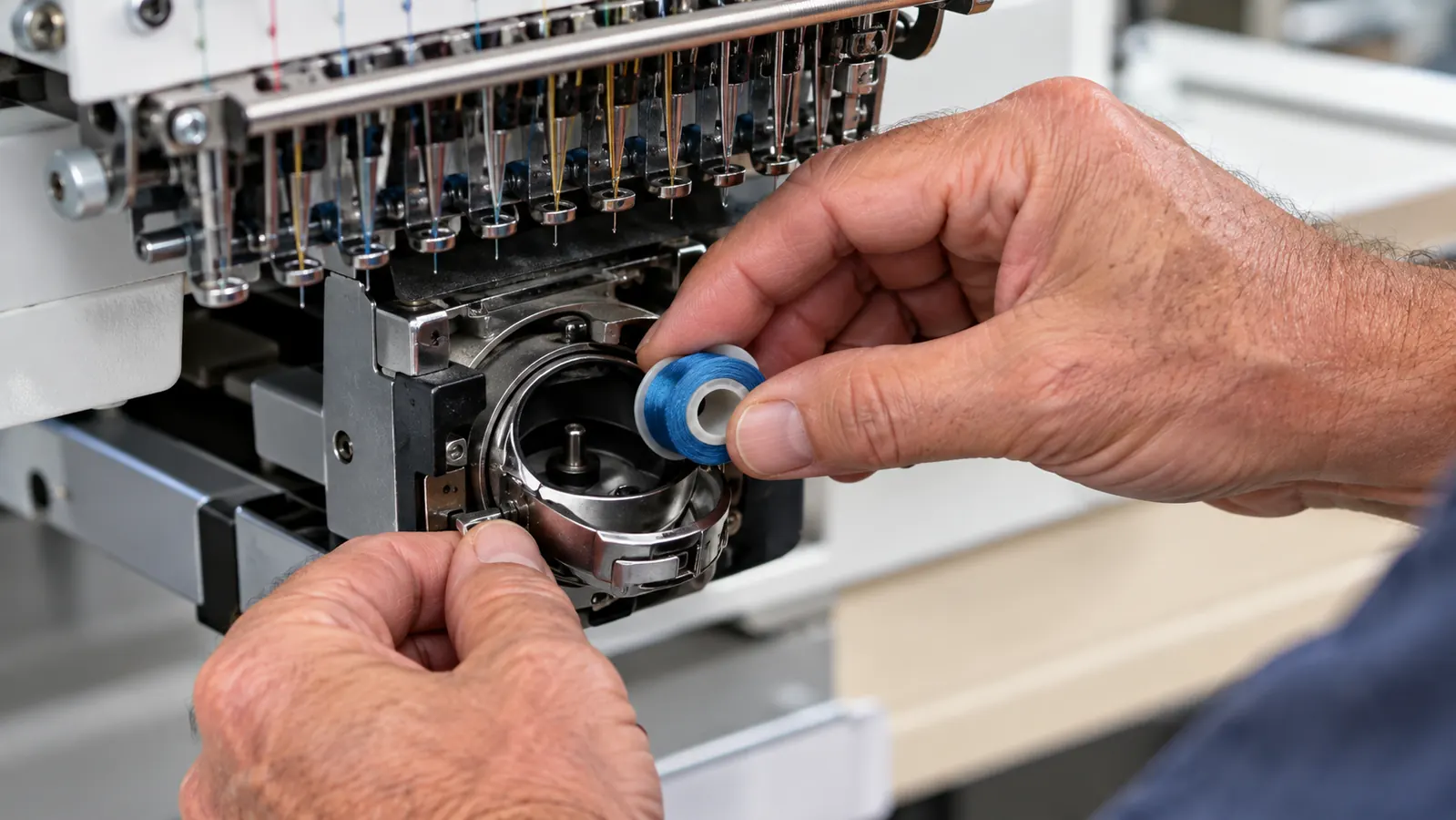
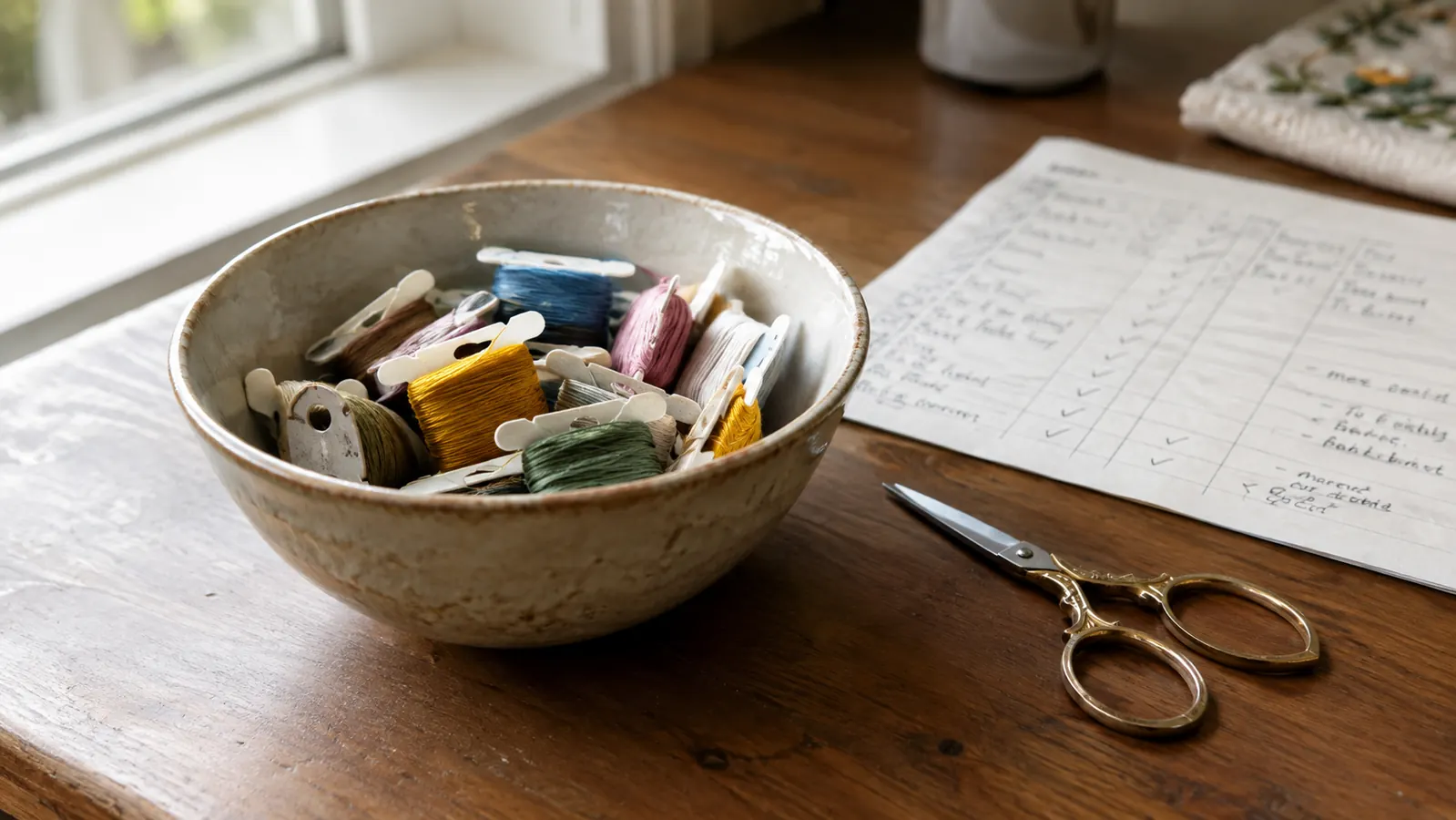
With the DOUBLELIN box, the routine changed to: open the box, drop a bobbin in, go. I keep a small ceramic bowl of them on the work table next to the machine. When a bobbin runs low, I swap in a fresh one in about twenty seconds. Over the first full month, I did not wind a single bobbin. That alone was worth the price of the box.
But I did not trust them at first. I ran a full set of test sew-outs before I put a single prewound bobbin into a paid order. I used a 40wt poly thread on the top and the white prewound bobbin on the bottom, and I stitched out a dense satin letter monogram, a small filled circle design, and a delicate underbase-heavy logo on cut-away stabilizer. I watched the back of every test piece for loose loops, for tension ridges, and for the bird-nesting that shows up at the bobbin area when things are not right. They were clean.
What Nobody Tells You About Prewound Bobbins
Here is the part I wish someone had told me before I ordered: prewound bobbins are wound tighter and more evenly than anything my machine's little winder ever produced. That even wind matters. When a bobbin is wound loosely or with uneven tension, the thread can shift and loosen inside the case, which changes the bobbin tension mid-design. That is when you get loops on the back, or thread nests at the start of a color block, or a design that registers fine on the third repeat but drifts on the tenth. My hand-wound bobbins were never terrible, but they were never this consistent either.
The other thing nobody tells you: the box of 144 bobbins will last you a long time, but not forever, and the count includes bobbins you will set aside because they have a slightly rough edge or an uneven patch of wind. In my box of 144, I set aside 6 bobbins that had visible imperfections: a small burr on the flange on two of them, and four with a spot where the wind looked slightly lumpy. That is about 4 percent. I did not use those in paid work. Six bobbins out of a 144-count box is not a reason to avoid the product, but it is a reason to sort through a new box before you need it, not while a customer is waiting.
A third thing: these bobbins are not universal. Size A is the standard for my machine, but your machine may take a different size, and a bobbin that is close but not exact can cause tension problems that look like thread breaks. Check your machine manual before you order. I checked mine twice, because I did not want to be the person who buys 144 bobbins that do not fit.
The thread breaks I blamed on the bobbins turned out to be a dull needle and a top tension that had drifted. The bobbins were doing their job the whole time.
The Test: 40 Orders, 300,000 Stitches, Zero Bobbin Failures
For the first month, I kept a tally sheet on the work table. Every order got a row, and I wrote down the number of pieces, the design type, how many bobbin changes I made, and whether anything went wrong that I could trace to the bobbin. I am glad I did, because the data saved me from my own assumptions.
The tally covered 41 orders. The work included 18 hat orders with a mix of structured and unstructured caps, 12 left-chest polo orders, 6 towel orders, 4 canvas bag orders for the barbecue place, and one church banner that I should have quoted double for. The stitch counts ranged from a 4,200-stitch left-chest logo to a 28,000-stitch back design on a canvas tote. Total across the 41 orders: roughly 312,000 stitches. I changed bobbins 87 times. Every single change was because the bobbin was running low, never because a bobbin had failed, come unwound, or caused a thread break.
The thread breaks that did happen during that month were a different story. There were nine of them. The first three, I assumed the bobbins were at fault, because that is the easiest thing to blame when you are behind schedule. But when I checked, I found the real causes: two were from a dull needle that had started to deflect on a dense cap design, four were from a top tension that had drifted after I cleaned the machine, and three were from a slightly rough spot in the cap backing that I should have hooped more carefully. I replaced the needle, re-set the top tension, and re-hooped the caps. The thread breaks stopped. The bobbins had nothing to do with any of them.
I also tested what happens when you let a prewound bobbin run very low, because I wanted to know where the safe stopping point was. With my hand-wound bobbins, I could stitch until the bobbin was nearly empty and the machine would keep going until the thread ran out, usually at the worst possible moment. With the DOUBLELIN bobbins, I found that the wind is even enough that the last layer of thread behaves almost as well as the first. There is no sudden looseness in the final 10 percent. The practical takeaway for me: I can safely run a bobbin down to about a quarter of its remaining thread and start a smaller design, which saves me from swapping bobbins on 6,000-stitch jobs when I only have a small logo left to stitch.
Where DOUBLELIN Prewound Bobbins Shine
These bobbins earn their keep in three specific situations. First is the high-volume color-change order, the kind where you stitch 20 hats with a two-color front logo and a one-color back text, and every piece needs a fresh bobbin. The ability to drop in a fresh bobbin in seconds instead of winding one on the machine is the difference between finishing a 40-piece order by 3:00 PM and finishing it by 5:30 PM.
Second is the dense design on a dark fabric, where bobbin thread shows on the edge of the stitch. The white bobbins are a clean match for the white 40wt top thread I use most often, and the consistent tension means I do not get the slight color shift that happens when a hand-wound bobbin loosens partway through a heavy fill.
Third is the late-night order, the one where you have already wound fourteen bobbins and you are not sure you wound the last one tightly enough. Knowing that every bobbin in the box is wound on the same machine, to the same tension, takes one more variable out of the equation. When a design runs 28,000 stitches and the bobbin is the only thing between you and a 9:00 PM restart, that consistency is worth real money.
Where DOUBLELIN Prewound Bobbins Fall Short
I want to be fair about the weaknesses, because an honest review has to name them. The first is the 6 bobbins I set aside out of the first box. Four percent is a small number, but it is not zero, and when you are in the middle of a rush order, even one bad bobbin is an interruption. I have not found a pattern to which bobbins are flawed. It is not the top of the stack or the bottom. It is random, which means you cannot just grab any bobbin and be certain it is good. Sorting a new box takes about ten minutes, and I recommend doing it before you are under pressure.
The second weakness is that the white bobbin thread is not a match for every fabric. When I stitch a dark navy polo with a white top thread, the white bobbin thread shows slightly on the back edge of a dense left-chest fill. It is not visible from the front, and most customers would never notice, but if you are stitching something where the back of the fabric will be seen, like a towel hanging over a rail or a sheer curtain panel, you need to think about whether white bobbin thread is the right call. I keep a few spools of black bobbin thread for those orders, and I wind those by hand when I need them.
The third weakness is the box itself. The 144 bobbins arrive in a simple cardboard box, and the bobbins are not individually wrapped. That is fine for a shop where they will be used within a few months, but if you buy a bulk box and store it in a humid garage or a damp basement, the cardboard can absorb moisture and transfer it to the bobbins. I learned this the hard way when I kept a spare box in my car over a humid Georgia summer. The top layer of bobbins felt slightly tacky, and one of them caused a tension issue in the bobbin case. I now store my bobbins in a lidded plastic container with a small silica packet, and I have not had a problem since.
What I Liked
- Cut my daily bobbin-winding time to zero for two full months
- Even, consistent wind that held tension through 40-plus orders and roughly 312,000 stitches
- No bobbin-related thread breaks, no bird-nesting, no registration drift in my testing
- White thread matched my standard 40wt white top thread cleanly on most fabrics
- 144-count box lasted me roughly two months of steady small-shop production
- Fast swap means less downtime on multi-color, multi-piece orders
Where It Falls Short
- About 4 percent of bobbins in my first box had visible flange or wind imperfections, so sorting is necessary
- White bobbin thread can show on the back of dark, sheer, or display-side fabrics
- Bulk cardboard box is not moisture-proof; bobbins need dry storage
- Only compatible with machines that take the exact bobbin size, so check your manual first
Who This Is For
Prewound bobbins from DOUBLELIN are for the embroiderer who runs more than a handful of orders a week and is tired of stopping the machine to wind bobbins. They are for the home shop owner who has missed a deadline because a hand-wound bobbin ran out in the middle of a 20-piece order. They are for anyone who wants one less variable between them and a clean, on-time delivery. If you run a six-needle machine like mine, or even a single-needle that you use most days, the time savings are real and measurable. I measured mine: 47 minutes of winding on a light day, down to zero. That is nearly an hour a day that went back into hooping, digitizing, or actually getting the orders out the door.
The size A bobbins fit my machine exactly. The white thread is a clean match for the 40wt poly white I use for most of my work. If your shop runs mostly white or light-colored thread, these are close to a no-brainer. If you mostly stitch dark fabrics where the bobbin thread might show, you will still find these useful for the majority of your jobs, but you will want a separate supply of dark bobbin thread for the visible-back pieces.
Who Should Skip It
You should skip prewound bobbins if you only stitch a few pieces a month for yourself or as gifts. The savings are real but small at that volume, and the upfront cost of a 144-count box is harder to justify when you might not use it up before the cardboard box starts to wear. You should also skip them if your machine takes an unusual bobbin size that is hard to source, because a bobbin that is close to the right size but not exact can cause tension problems that are worse than the winding inconvenience you are trying to solve.
You should also think twice if you do the kind of work where the back of the fabric is the finished side, like towels that hang over a rail or bags where the inside is visible. For that work, you need bobbin thread that matches the fabric, and a bulk box of white prewounds is not the right tool for every single job. I still keep my hand-winder for those occasions. It gets used less than it used to, but I have not thrown it away.
Two months of orders, zero bobbin failures.
That is what DOUBLELIN prewound bobbins did for my shop. If you run a multi-needle machine on real deadlines, the time savings are immediate. Check today's price on Amazon and see if size A fits your machine.
Amazon Check Today's Price on Amazon →