When I started machine embroidery in 2016, I did what most home sewers do. I left the universal needle in the machine and hoped for the best. It worked fine for towels and practice pieces. Then a rush order of left-chest polos for an HVAC company showed me the difference. The first shirt skipped stitches in the lettering. By the fourth shirt I had called the dealer, ordered SCHMETZ Gold Embroidery needles, and started keeping a notebook. Every job that went sideways went into that notebook so I could find the pattern. After seven years and thousands of pieces, the pattern is clear. Needle choice shows up before thread choice, before stabilizer, and before digitizing, but only when the design is dense and the fabric is stretchy.
Here is the short answer. Embroidery needles and universal needles are not the same needle with a more expensive name. The eye is shaped differently, the scarf is deeper, the point has a light ball, and the coating is made to handle heat. If you hoop fabric and run dense satin stitches, that geometry matters more than your thread brand or your stabilizer. A universal needle will sew a seam all day. It will not give you clean small letters on a stretchy polo at embroidery speed. The two needles look close sitting on a card, but they behave like different tools once the machine reaches full speed.
| SCHMETZ Gold Embroidery Needles | Universal Needles | |
|---|---|---|
| Hoop work on stretch knits | Light ball point slides between the fibers, so small letters stay closed on a polo. | Slightly sharp point can cut the knit and cause skipped stitches on curved letters. |
| Dense cap fronts | Deeper scarf and polished eye keep the thread in line when the needle crosses buckram. | Rounder eye and shorter scarf let the thread slap and skip on the cap front seam. |
| Woven seams and hems | Ball point pushes against tightly woven cotton and denim rather than piercing it. | Slightly sharp point pierces those fabrics cleanly and makes a neat flat seam. |
| Long-run heat | Titanium coating sheds heat on a 5,000-stitch logo and keeps synthetic thread from melting. | Standard finish gets hot after a few thousand stitches on the same design. |
| Thread wear | Long eye and polished scarf protect 40-weight polyester from shredding into lint. | Smaller eye abrades specialty thread and causes lint buildup in the tension discs. |
| Everyday general sewing | A specialty embroidery needle works if it is already in the machine, but it is overkill. | Universal needles handle a range of woven fabrics, zippers, and repairs without a lot of swapping. |
| Cost per needle | A five-card pack of specialty needles costs a little more per needle. | A basic pack of universal needles is the budget option. |
| Sewing without a hoop | Best kept for hooped embroidery jobs with digitized designs. | Best kept in a general purpose machine for hems and household repairs. |
Where SCHMETZ Gold Embroidery Needles Win
The first time I noticed the difference was not in the needle plate. It was in the thread. I ran a barbecue restaurant logo with a gradient fill, and the universal needle turned the 40-weight polyester into lint in the tension discs. I cleaned the machine, switched one position to a SCHMETZ Gold 90/14 from the five-card pack, and ran the same design again. The lint vanished. I repeated the test two weeks later with a fresh universal needle to be fair, and the same lint came back. The thread was rubbing against a rough edge inside the eye of the universal on every stitch. You cannot feel that from the top of the hoop, but you can see it in your tension and in the fuzz under the needle plate.
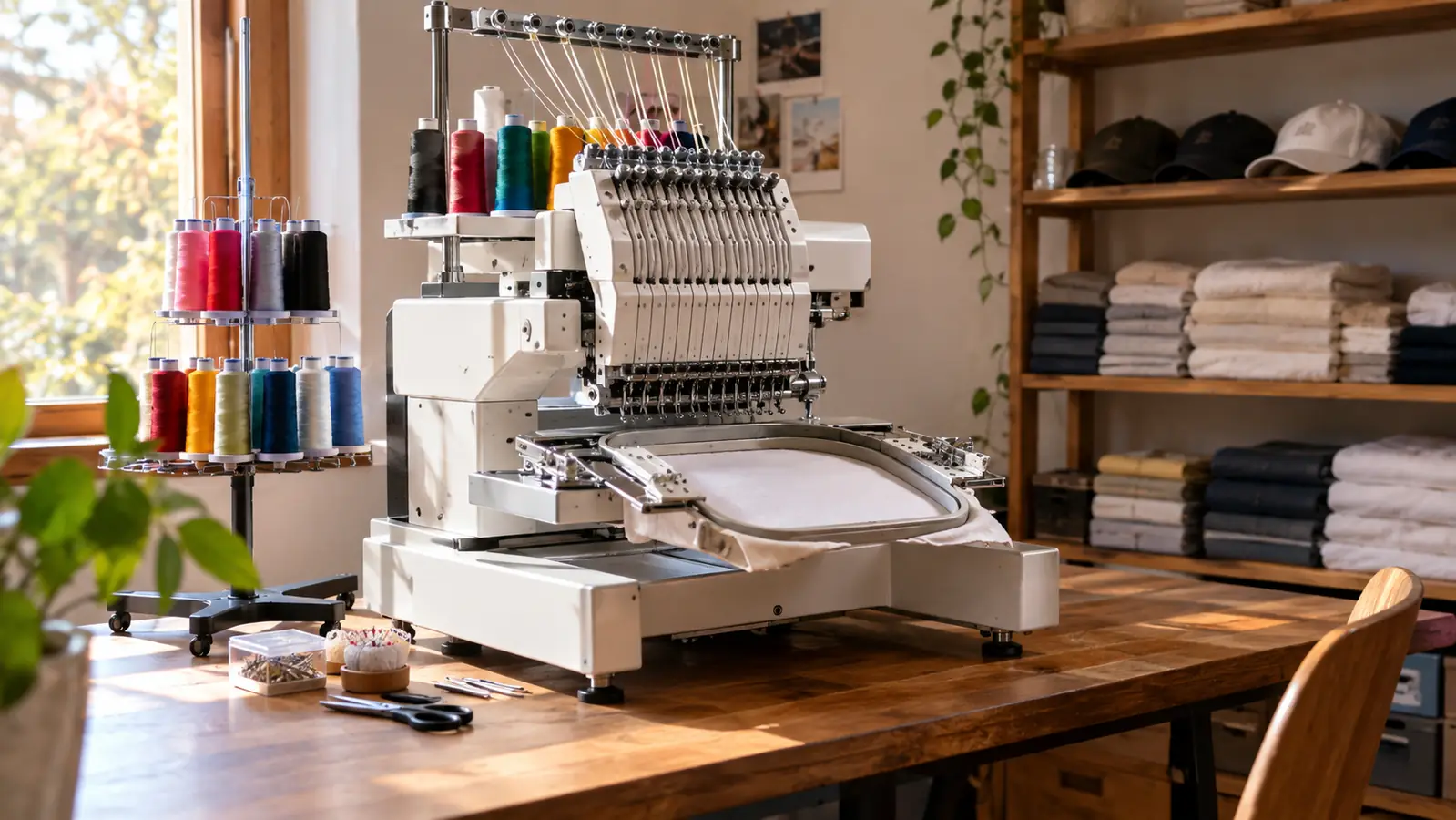
On a hat, the change is easier to see. A baseball cap has a front seam, a layer of buckram, and a folded sweatband, all in one pass. The needle has to push through all of it without bending or deflecting. With a universal needle, I got a skip on the first letter of the team name every third hat. I switched all six positions to SCHMETZ Gold 90/14 and ran the same design on a full order of 32 caps for a little league team. Every cap sewed clean. I dated the entry in my notebook because I had not finished a cap order without one rerun in months.
I also learned to respect the 90/14 size. For a lightweight performance jersey that shows every needle hole, I go down to a 75/11 SCHMETZ Gold. For hats and towels and thick canvas bags, I stay with 90/14. The point shape stays the same. The titanium coating keeps the shaft cool, so synthetic thread does not stretch, melt, or break on a long satin column. It does not make the needle indestructible. I still change my needles after eight to ten hours of run time or after any job with metallic thread. A burr on the eye will show up as a thread break no matter how good the needle was the day before.
I want to be fair about something else. Not every skipped stitch or thread break is a needle issue. Hoop tension, a dull rotary blade, a dirty hook race, or a design that asks a small needle to punch through three layers of cap buckram can all cause the same symptom. So I always run a diagnostic. I change the needle first because it is the cheapest and easiest change, and I keep the test design on the same fabric. If a SCHMETZ Gold needle does not fix it, I look at the hook timing and the hoop. That process gets me to the real problem fast and keeps me from blaming the wrong part.
One more thing that surprised me is how a new needle can change the sound of the machine. When I ran a tired universal through a dense towel logo, the head had a dull thump on every revolution. After I switched to a fresh SCHMETZ Gold needle, the same design sounded smoother and more even. I use that sound as a clue now. If a file that used to run quiet starts making a rhythmic beating noise, I stop and change the needle before I pull a finished piece off the hoop.
I also want to say something about needle size because I see confusion there all the time. The number on the package, 75/11 or 90/14, refers to the diameter of the shaft. It does not tell you whether the point is right for knit fabric. A 90/14 universal will still skip on a cap even though it is the same size as the SCHMETZ Gold 90/14 that runs clean. The shape of the scarf and the eye are part of the equation. That is why I trust the brand label on the card more than the number alone.
A skipped stitch on the first letter of a cap is not a tension problem. It is usually a needle problem.
Where Universal Needles Win
Do not throw away your universal needles. The slightly sharp point of a universal is better for jobs that do not involve a hoop. Hemming a kitchen towel, easing a canvas bag strap through a tight seam, and stitching a label into the inside of a cap all go better with a needle that pierces woven fabric instead of slipping between the threads. When I repair a cotton work shirt for one of the HVAC customers, the straight stitches lie flat with less puckering on a universal needle. It is the correct tool for that specific job even though it fails on a dense polo logo at high speed.
A universal needle may also be the right choice for a beginner machine that does a little of everything. If you sew knits in the morning, mend a pair of pants in the afternoon, and quilt a small panel at night, switching needles for every project is a pain. A universal needle handles all of those tasks well enough. The trouble begins when you push it past the job it was built for. I kept three universal needles in a small dish on my work table for years, and I reached for them several times a week. They earned their place.
When I gave universal needles an honest trial, I used them on denim, cotton duck, broadcloth, and quilting cotton. On woven fabric they started clean and stayed clean. The failures only started after I hooped a stretchy polo or a dense cap logo. So do not treat this as a test with one winner. Treat it as two tools with two jobs. If most of your work is hooped decor on knit fabric, the specialty needle wins. If most of your work is seams, the universal needle saves you money and gives you a cleaner stitch on woven goods.
There is one edge case worth knowing. If you run a small piece of woven fabric in an embroidery hoop, like a linen guest towel or a cotton bag panel, the universal needle can actually give you a crisper stitch on the straight parts of the design. The difference only appears when the design crosses a seam, hits a fold, or sews through a heavy cap front. So if all you embroider is flat woven blanks, you can skip the specialty needles and save them for the jobs with seams and stretch.
Universal needles have earned their place in the sewing world, and I am not going to pretend otherwise. My own sewing basket still has a few of them for the plain mending I do around the house, and I have used them to stitch a folded patch onto a canvas work bag when I did not want to rethread the embroidery machine. The point is knowing that every needle has a speed and a fabric it likes. Universal needles like stable woven fabric at a moderate speed. Embroidery needles like dense hooped designs at embroidery speed.
Skipped stitches on the first letter of a cap? Start with the needle.
Before you change thread, digitizing, or machine timing, do the simplest test. Put a SCHMETZ Gold 90/14 in every position and run the same design. If the skip disappears, you have your answer. That is why I keep a card of five on the shelf.
Amazon Check Today's Price on Amazon →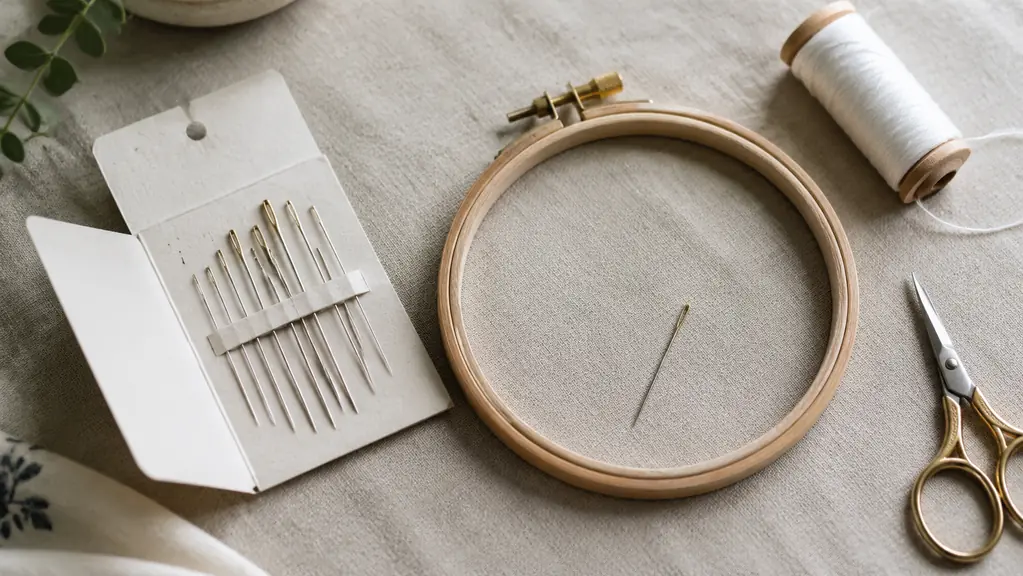
Who Should Buy Which
Buy SCHMETZ Gold embroidery needles if you hoop fabric on a dedicated embroidery machine, even if it is just one machine in a spare bedroom like mine. Buy them before you spend money on extra stabilizers or a dozen thread colors to fix a skipped stitch that is really a needle problem. The 90/14 size covers most 40-weight polyester work, and a five-card pack is enough to keep every position on a multi-needle machine ready at the same time.
Stick with universal needles if your machine does mostly seams, mends, and hems, and you only hoop a few towels with names for Christmas gifts. On lighter designs, a universal needle keeps up. The fabric is often a stable woven or a looped terry that does not push back the way a cap seam does. You will not see a difference on a simple name under the cuff of a towel. Save the specialty needles for the dense jobs that ask more of the point and the eye.
Here is the test I give people. Run one medium-density logo on a cap with the needle you already have. If you see a skip, do not blame the thread, the tension, or the machine. Switch to a SCHMETZ Gold 90/14 and run the same file. If the skip goes away, you have found the source. If it does not, you need to look at the hook timing or the hooping. Nine times out of ten in my notebook, the skip went away when the needle changed.
Needle size matters too, but I do not overthink it. I keep 90/14 in my machine for almost everything because it is large enough for dense caps and smooth enough for polos. For a lightweight polyester jersey that shows every needle hole, I switch to 75/11 and test the same file. The fabric tells you which one it wants. Stock both sizes in a five-card pack and you can run a small job without a long wait for a restock.
If you are still on the fence, buy one five-card pack and run a side-by-side test. Put a universal needle in the fourth position and leave SCHMETZ Gold in the other five. Use the same design, same hoop, same backing, same thread. When the universal position skips and the SCHMETZ position does not, the evidence is right there on the cloth. I did exactly that and it ended my doubts without a single debate.
Change needles when you change jobs, too. A 90/14 SCHMETZ Gold that ran fine through towels may need replacing before a cap job. I keep a card of 75/11 and a card of 90/14 within reach, and I write the date I opened the card on the peel-off label. That habit saves me more shirts than any stabilizer ever did.
If you buy one five-card pack and keep it on your shelf, you will use it more than you expect. I did not switch every job at first. I told myself I would save the SCHMETZ Gold needles for difficult hats and go back to universal for towels. Within two months I stopped going back. The clean runs saved me enough time and fabric that the cost difference stopped mattering. That is not a push to overspend. It is just what happens when you see the same design sew clean twice.
The needle is the least expensive fix you can try.
On your next hat order, put a SCHMETZ Gold 90/14 in every position before you adjust tension. If the small letters stop skipping, you will know you saved yourself a whole evening of frustration.
Amazon Check Today's Price on Amazon →