
Which should you use, tear away or cut away? I answer that question at least once a week, usually from a fellow embroiderer who just spent an evening trimming mesh off a stack of caps and wants to know if there is a faster way. There is. Tear away is for fabric that holds still under the needle. Cut away is for fabric that stretches when you pull on it. That single rule has saved me more shirts than every other lesson I paid for with ruined orders and wasted thread. I am Ruthann Kessler. I run a six-needle embroidery machine out of a converted spare bedroom in Macon, Georgia, stitching small runs of hats, towels, polos, and canvas bags for local ball teams, churches, an HVAC company, and one barbecue place.
Before I get into the details, let me be clear about what this comparison is and is not. New brothread makes a 12 inch by 50 yard roll of tear away stabilizer, and on most mornings it is the roll I grab first. But I am not going to tell you to throw away every roll of cut away you own, because cut away does one job that tear away cannot do. The goal here is to help you know the difference, name what each backing is actually built for, and walk away with a ten second test you can run before you hoop anything. I will also tell you about the order that proved the limits of tear away to me, because that is the part most stabilizer advice leaves out.
Tear Away vs Cut Away at a Glance
| New brothread Tear Away | Cut Away Stabilizer | |
|---|---|---|
| Removing it after the run | Tear the excess away by hand in seconds. No scissors, no trimming steps. | Trim around the whole design with curved snips, two or three minutes per piece. |
| What it supports best | Stable wovens: cotton caps, pique polos, towels, canvas, denim. | Stretch knits: performance polos, jersey tees, anything with spandex. |
| Structured caps and brims | Pulls clean inside the crown; no leftover edge against the buckram. | Leaves a trimmed mesh edge you cannot get flat under a curved brim. |
| Behavior on stretchy knits | Once the backing is gone, nothing anchors the stitches when the knit moves. | The backing stays in place and keeps each stitch column where it belongs. |
| Towels and textured fabric | Comes away clean, so terry loops never catch or pull. | Trimming on terry risks clipping a loop, which becomes a run in the wash. |
| Design after many wash cycles | Depends on the fabric; fine on stable weave, less fine on anything stretchy. | Gives permanent structure, so the design holds its shape longer on knits. |
Where Tear Away Wins
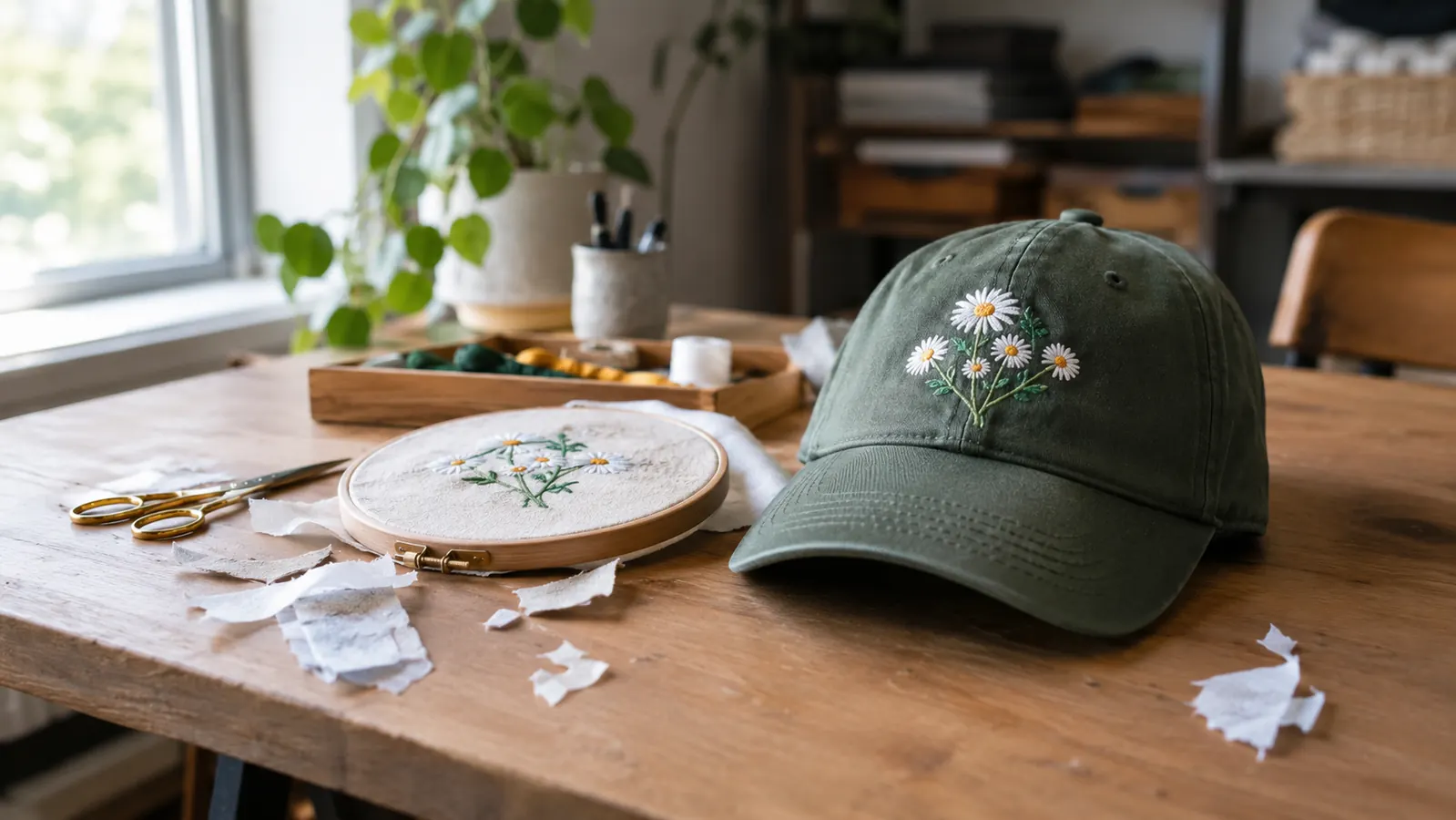
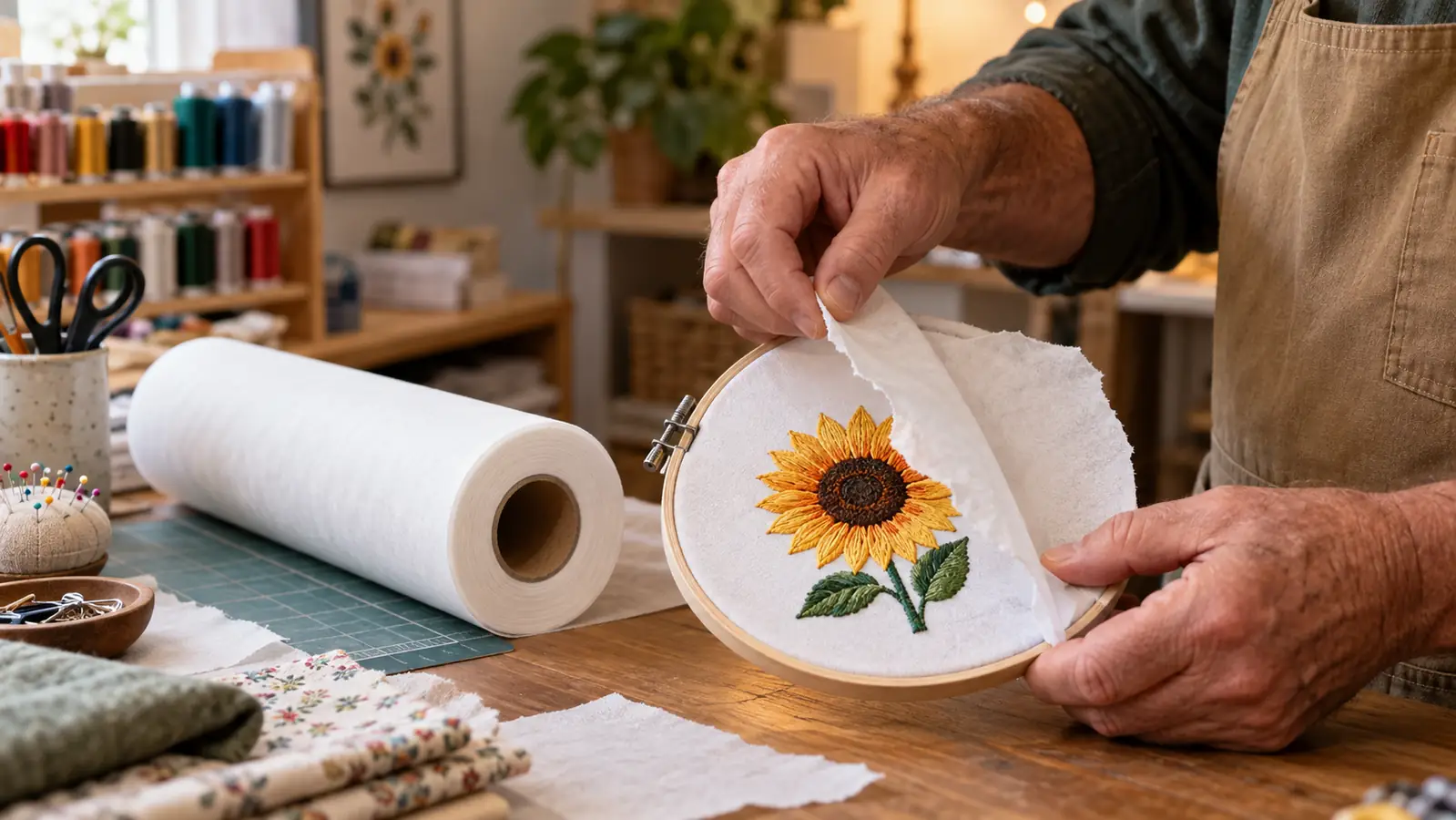
You will feel the difference at the end of the run, not the beginning. Last spring I stitched 36 structured caps with buckram fronts for a church softball league, a small interlocking design on the front panel of each cap. Both stabilizers went through the hoop and behaved identically, and both looked clean until I turned the first cap inside out to finish the back. With cut away you cannot get a pair of curved snips flat against a curved brim. Every little triangle of leftover mesh pressed against the buckram and left a ridge that the players would have felt every time they put the cap on. I rehooped that same cap with New brothread tear away and the whole job changed. Flip the cap, pull the excess toward the center, and the backing tears clean along the stitch line in one motion. No scissors, no trimming, no ridge. I finished and inspected all 36 caps in about the time it would have taken me to trim three or four with cut away.
The other place tear away earns its keep is textured fabric, and the best example I know is a towel. A terry loop will grab hold of a loose backing edge like it is trying to keep it. I stitched an order of kitchen towels for that barbecue place, a thick dense logo with heavy satin stitching that covered most of the middle of each towel. The thought of putting scissors anywhere near those loops made me cringe, because one slip nips a loop and a nipped loop turns into a pulled thread after a few wash cycles. Tear away solved the whole problem. The backing tore clean along the design, I never touched the loops with a blade, and the towels came out soft with no stiff residue on the back. The same reasoning covers canvas tote bags and the woven pique polos that half my customers wear on job sites. When you want a clean finish and a fast removal step, this is the stabilizer that delivers both.
One more thing I appreciate about tear away: there is no learning curve to the cleanup. Cut away demands a steady hand, a sharp pair of curved snips, and the patience to trim close without nicking threads. Tear away simply breaks. If it does not tear clean, that usually means I used a lightweight sheet where I needed a firmer one, so I switch to a second layer or a firmer roll. That is a much easier fix than rescuing a shirt I trimmed too close.
Where Cut Away Wins
I learned the limit of tear away the hard way, on an order I would rather forget. A contractor asked me to stitch 16 black performance polos, the knit kind with spandex in it, with a logo on the left chest. I hooped the first shirt with a heavier tear away, ran the logo, and it looked sharp coming off the machine. A week later the customer called. After the first wash, the letters at the bottom of the logo had gone wavy and in two spots the dark knit was pushing up through the design. That is what happens when you take the backing out from under fabric that still wants to move. Every time somebody pulls that shirt over their head, the knit stretches, and with nothing left underneath, the stitches slowly walk out of shape all on their own.
Cut away prevents that failure because the backing stays in the shirt for the life of the garment. You trim it close to the design, but a layer of mesh stays underneath, and that mesh gives every stitch column something to lean on no matter how many times the shirt gets stretched, washed, and dried. I removed the embroidery from one of those black polos, hooped it with cut away, and stitched the same file a second time. That shirt has been through a construction job site and months of laundry since, and the logo still sits as flat as the day it came off the needle. If you tug the fabric and it ripples, or if it stretches and does not snap straight back, that is a cut away job. Do not argue with the fabric. It will always win.
Keep the roll that handles caps, towels, and totes
New brothread tear away is a 12 inch by 50 yard roll, and it has carried me through hundreds of caps and towels with no scissors in sight. If you are trimming cut away off hats today, this is the fix for your next stable fabric order. Check today's price on Amazon and see if it makes sense for your shop.
Amazon Check Today's Price on Amazon →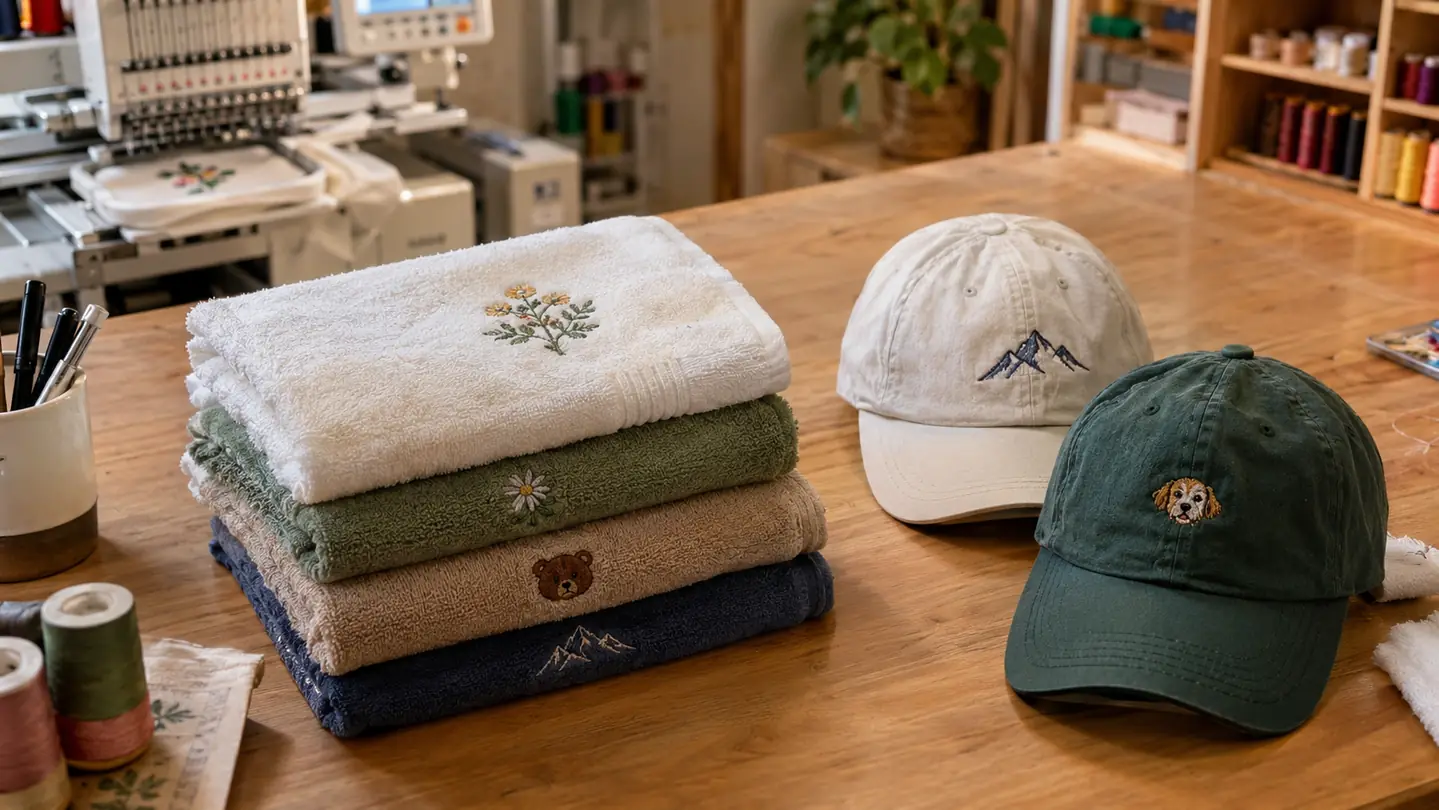
The Ten Second Test That Settles It
You do not need a spreadsheet to make this call. Take the fabric you are about to stitch and stretch it between both hands the way you would test a hem. Pull it across the chest, along the bias, and shoulder to shoulder, and watch what it does. If it holds flat and snaps back without rippling, it is stable, so use tear away and keep moving. If the knit opens up, if you can see gaps between the yarns, or if it stays stretched for a beat before settling back down, treat it as stretchy and reach for cut away. I run that test on every new fabric that comes into my workroom, even when a customer swears the shirts are plain cotton. Plenty of what gets sold as a basic cotton tee today has a little spandex blended in, and it does not behave the way cotton did twenty years ago.
The second half of the test is about the life of the finished piece. Will it be washed hard and stretched every week, like a team practice shirt? Or does it live on a shelf, like a birthday tote bag? If it gets yanked on and off and thrown in a dryer, give it a permanent backing. If it only needs to look good for a season, tear away is plenty. And if you are still not sure after the stretch test, stitch a sample the night before the job. Hoop a scrap of the actual fabric, run a small version of the design, finish it the same way you plan to finish the order, and wash it once. Fifteen minutes of your evening will tell you more than an hour of reading product labels ever will.
Who Should Buy Which
If your week looks anything like mine, tear away is the stabilizer you will use the most. My orders run heavily toward hats, towels, and canvas totes, with a woven polo order mixed in every couple of weeks. All of those are stable fabrics, and New brothread tear away handles every one of them without a second thought. I keep the 12 inch roll because that width covers a left chest logo and most front cap designs, and 50 yards means I am not stocking up again every month. Across one season that same roll has done two softball teams' worth of caps, a stack of barbecue restaurant towels, a run of canvas totes for a church fundraiser, and the pique polos for the heating and air office staff. One stabilizer, a dozen different jobs, and not one trimming step in the bunch.
But here is the honest part, and I want you to hear it plainly. If your customers bring you performance wear, if you stitch athletic practice shirts, running singlets, or those soft blended tees, buy a roll of cut away too, and do not pretend otherwise. The two stabilizers are not enemies. They are different tools, and every shop that does consistently good work keeps both on the shelf. The reason I recommend New brothread tear away first is simple. On an ordinary Tuesday, when the order is a dozen caps and a handful of towels, tear away is the roll you will reach for every time, and it will never let you down on those jobs.
If you are only going to buy one roll today, ask yourself which fabric shows up in your hoop most weeks. If the answer is caps, towels, or totes, New brothread tear away is the roll to order. If the answer is stretchy athletic knit, buy cut away first instead and keep this page for the day a hat order walks through the door. If you split your work evenly between stable and stretchy fabrics, buy the tear away first, because it is the one that saves you time on the jobs that make up the bulk of your week. Then add a cut away roll and label it clearly so you do not grab the wrong one when you are in a hurry. That is the whole decision, and no fancier product name is going to change it.
Give Tear Away a Try on Your Next Stable Fabric Job
New brothread tear away has carried me through hundreds of caps and towels, and a single roll lasts a long time in a home shop. It tears clean, leaves no stiff ridges, and keeps you out of the trimming chair. Check today's price on Amazon and compare it with the roll you are wrestling with right now.
Amazon Check Today's Price on Amazon →